
Air Source Heat Pump Servicing in Central Scotland
Ecofix Scotland provides routine servicing for air-to-water and air-to-air heat pumps as part of our wider air source heat pump services across North and South Lanarkshire and selected Central Scotland postcodes.
A heat-pump service is more than a quick visual check. The purpose of the visit is to assess the accessible equipment and system operation, record relevant observations, identify signs of deterioration or abnormal performance and explain any findings that may require further attention.
Every routine heat-pump service is carried out by Ian Patterson and supported by a written or digital Ecofix service report.
Request a heat-pump service
Call, SMS or WhatsApp: 07846 834155
Email: ian@ecofixscot.co.uk
Form: Contact us
Service scope and price
Before booking, we confirm the price for your postcode and the equipment and routine checks included. The standard air-to-water service covers one suitable domestic-scale heat-pump system, its associated indoor and hydraulic equipment and accessible normal controls, with normal travel and a structured service report included.
Allow around 2–3 hours on site for a normal air-to-water service. Safe ordinary access and suitable manufacturer information are required. Multiple systems, cascades, larger commercial equipment and unusual installations need an individual estimate.
An agreed fixed-price routine service does not become hourly work simply because the accepted checks take longer than expected. Any change of scope or exceptional work is explained and agreed separately. Applicable manufacturer checks are not omitted to fit a nominal visit time.
What happens during a heat-pump service?
The exact checks required depend on:
Ecofix therefore does not use a single rigid checklist and claim that it is appropriate for every heat pump.
Where the manufacturer specifies additional or different service requirements, those instructions are followed where they are available, applicable and within the engineer’s competence and authorisation.
Before the service begins
The visit starts by confirming the system and discussing its recent operation.
Where information is available, this may include:
A reported concern is recorded, but a routine service should not automatically be treated as an extended fault-diagnosis visit.
If an active fault is already known to require investigation, the visit should be arranged as fault diagnosis. If an additional fault becomes apparent during a routine service, the findings and proposed extra work will be explained before significant diagnostic work is undertaken.
General equipment and condition checks
Where relevant and reasonably accessible, a routine service may include assessment of:
The purpose is to record what is actually observed rather than infer the condition of components that cannot be inspected.
Controls and system operation
The controller and connected controls provide useful information about how the system is operating.
Depending on the equipment, the service may include review of:
Problems affecting system operation can sometimes originate in the wider heating controls rather than the heat-pump unit itself. Find out more about heat-pump controls and associated equipment.
Settings are not changed simply because a different setting might appear preferable. Their purpose and effect must first be understood.
Where an adjustment is appropriate, it will be recorded.
Air-to-water heat-pump servicing
For an air-to-water system, relevant checks may include:
Not every system contains all of these components.
More information about suitable cylinder-related work is available under heat-pump hot-water cylinders.
Strainers and hydraulic components
Accessible strainers or filters may be visually assessed where possible.
Cleaning a strainer is not automatically included where the work requires:
Where further work is advisable, it will be explained before proceeding.
Air-to-air heat-pump servicing
Air-to-air heat pumps are also commonly referred to as air-conditioning systems. Where the work matches our established Air Conditioning service, the same service and charging rules apply. We confirm the applicable price and included scope before booking.
For suitable air-to-air equipment, servicing may include:
Deep cleaning, chemical cleaning, extensive dismantling or remediation of heavily contaminated equipment is not automatically included within a routine heat-pump service.
Where this is required, it will be treated as additional work.
Refrigerant-side observations
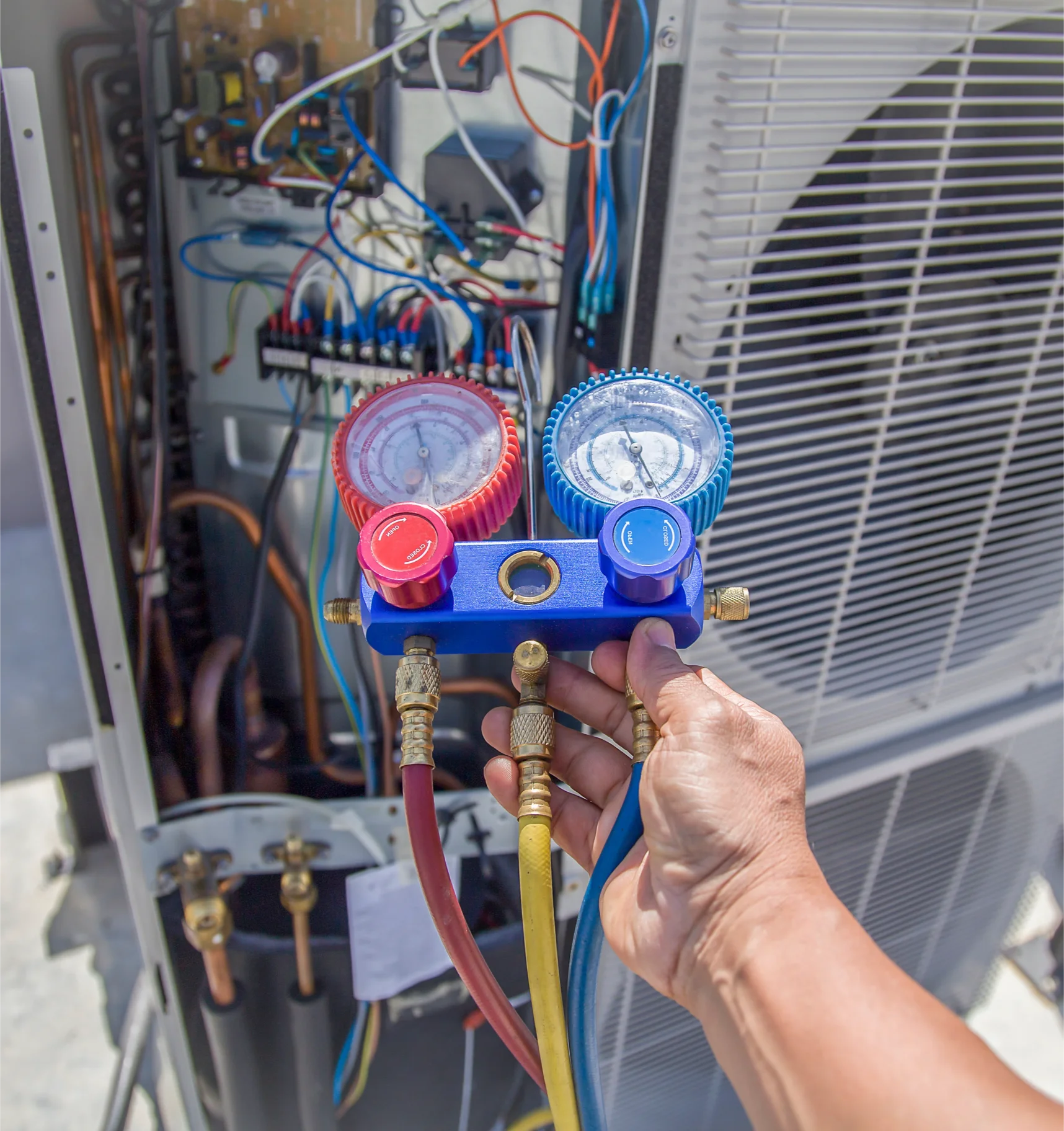
During routine servicing, refrigerant-side work is based on technical need rather than automatically connecting gauges to every system.
The service may include:
Intrusive refrigerant testing, recovery, charging or leak repair is not automatically part of a routine service.
Such work is undertaken only where technically justified, appropriate and within the required qualification and authorisation.
Light cleaning and minor adjustments
Where suitable, minor work may be completed as part of the routine service where it:
Examples may include light cleaning of accessible reusable filters or minor adjustments where appropriate.
Any work completed is recorded in the service report.
Your Ecofix heat-pump service report
Every routine heat-pump service receives a structured Air Source Heat Pump Routine Service Report.
The report records relevant information such as:
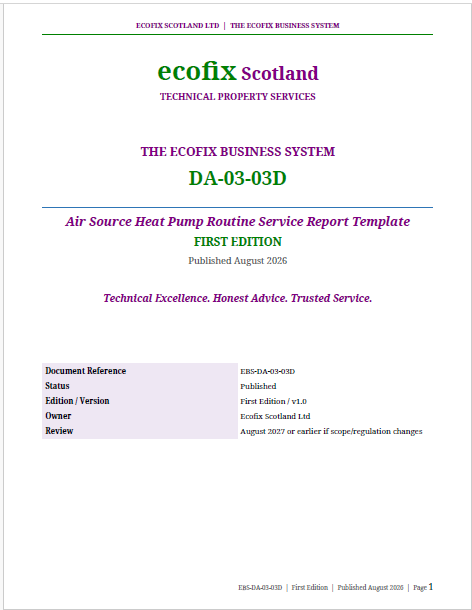
Possible outcomes include:
The report provides a record of the condition and observations made during that particular visit.
What happens if a fault is discovered?
Finding a fault during servicing does not mean that a component should immediately be replaced.
If a significant active problem becomes apparent, the next step depends on the evidence available.
The process is normally:
Service observation → fault identified or suspected → findings explained → diagnostic work agreed where required → diagnosis → repair estimate → customer authorisation → repair → verification
If the cause is already established and the repair is straightforward, further work may sometimes be agreed during the same attendance. Only the agreed additional engineering and materials are added for that continuation; a second full attendance charge is not added to the same visit.
Where the cause has not been established, further heat pump fault diagnosis may be required. Once the cause has been confirmed, see how Ecofix approaches heat pump repairs.
Ecofix follows a simple principle:
Repair the cause, not just the symptom.
What is not automatically included in a routine service?
Unless specifically agreed, routine heat-pump servicing does not automatically include:
If additional work is recommended, it will be discussed separately.
What a service can — and cannot — tell you
Routine servicing provides an opportunity to assess accessible equipment and identify signs that deserve attention.
It does not certify that the entire system is free from hidden or developing faults.
A service also cannot guarantee:
Where a concern cannot be resolved through routine servicing, further diagnosis can be recommended.
This distinction is important because Ecofix would rather explain uncertainty accurately than make a promise that the evidence does not support.
Manufacturer requirements
Heat pumps differ considerably between manufacturers and models.
Manufacturer service instructions may specify particular:
Where applicable information is available, manufacturer-specific requirements take precedence over a generic checklist where they fall within Ecofix Scotland’s competence and authorised scope.
Qualified technical support
Ian Patterson holds relevant qualifications covering domestic air source heat pumps, F-gas work and associated systems, supported by manufacturer-specific heat-pump training.
View the full Heat Pump Qualifications & Certifications.
Systems and manufacturers supported
Ecofix Scotland services suitable:
Other manufacturers may be supported even where they are not specifically listed on the Qualifications & Certifications page, subject to:
Ground-source heat pumps
Ecofix Scotland does not currently undertake ground-source heat-pump work.
Complete heat-pump installation
Ecofix Scotland currently concentrates on:
Complete new heat-pump installation is not currently offered.
Service area
Heat Pump services are provided across Ecofix Scotland’s Normal Service Area. Suitable work outside the Normal Service Area may be considered by prior agreement.
See the Ecofix Scotland Service Area page for the current postcode allocation and geographic detail.
Related Heat Pump Services
Frequently asked questions
How often should an air source heat pump be serviced?
There is no single interval that should automatically be applied to every heat pump.
The appropriate servicing interval depends on the manufacturer’s requirements, system type, equipment use, operating environment and any applicable warranty conditions.
The manufacturer’s instructions should therefore be checked for the particular system.
Is fault diagnosis included in a routine service?
Routine servicing includes normal observations and operating checks, and a defect may become apparent during them.
Extended investigation of an active fault is different from routine servicing.
If additional diagnostic work is required, the finding and proposed next step will be explained before significant extra work is undertaken.
Will you service a heat pump installed by another company?
Yes, suitable systems installed by another company may be accepted.
This is subject to the system type, condition, accessibility, available technical information and the required work being within Ecofix’s competence and authorised scope.
Do you connect refrigerant gauges during every service?
No.
Connecting gauges or carrying out intrusive refrigerant-system testing should have a technical purpose rather than being undertaken automatically.
Further refrigerant testing is carried out where appropriate and justified.
Can you service my heat-pump hot-water cylinder as well?
Relevant accessible cylinder and hot-water observations can form part of the agreed heat-pump service. This does not automatically include a complete unvented-cylinder service. If a complete cylinder service or combined package is required, its scope and estimate are agreed before booking.
Ecofix Scotland holds the relevant BPEC qualification for domestic unvented hot-water storage systems.
Additional cylinder repairs or work outside routine heat-pump servicing will be discussed separately.
Do you service air-conditioning systems?
Air-to-air heat pumps are commonly described as air-conditioning systems and may provide heating and cooling.
Suitable air-to-air equipment can be serviced by Ecofix Scotland.
More specific information is available through the Air Conditioning division.
Do you install heat pumps?
No. Complete heat-pump installation is not currently offered.
Ecofix Scotland currently concentrates on servicing, fault diagnosis and repair.
Do you guarantee that servicing will prevent breakdowns?
No responsible service can guarantee that a mechanical, electrical or refrigeration system will not develop a future fault.
The service records the checks and observations completed during the visit and identifies issues that are apparent within that scope.
Request an air source heat-pump service
If you would like to arrange a routine heat-pump service, please provide:
Call, SMS or WhatsApp: 07846 834155
Email: ian@ecofixscot.co.uk
Alternatively, use the Ecofix Scotland enquiry form and select: